The global recycling landscape is currently navigating its most transformative era since the inception of industrial waste management. As we move through 2026, the traditional image of a “scrap yard”—defined by manual labor, magnetic cranes, and heavy air pollution—is being replaced by sterile, high-tech facilities driven by Artificial Intelligence (AI). This shift is not merely a matter of convenience; it is a response to a global crisis in resource scarcity and the urgent need for a “Circular Economy.”
The integration of Machine Learning (ML) and sophisticated sensor arrays has turned metal recovery into a precision-driven science. For researchers and students delving into these complex industrial shifts, the technical documentation required can be overwhelming. Many scholars find that utilizing Assignment Help Online at myassignmenthelp allows them to better synthesize these rapid advancements in environmental engineering and data analytics, ensuring their academic contributions remain at the cutting edge of 2026’s green tech revolution.
1. The Critical Failure of Manual Sorting
To understand the AI revolution, one must first look at the limitations of the “Legacy System.” Historically, metal sorting relied on three main methods:
- Manual Hand-Picking: Slow, dangerous, and prone to 20%–30% error rates.
- Magnetic Separation: Effective only for ferrous metals (iron/steel).
- Eddy Current Separators: Good for non-ferrous metals but struggles with “heavy” alloys or tiny shredded fragments.
The result of these limitations was “Downcycling”—where high-quality aluminum was mixed with lower-grade alloys, reducing its value and making it unusable for high-end manufacturing like aerospace or EV production.
2. The Anatomy of an AI-Driven Recycling Plant
Modern facilities, such as those operated by industry leaders like SP-Recycling, utilize a “Multimodal Sensor Fusion” approach. This isn’t just one camera; it is a synchronized system of digital “senses.”
A. Computer Vision and RGB Imaging
High-speed cameras capture over 1,000 images per second as scrap travels along a conveyor belt at speeds exceeding 3 meters per second. The AI is trained on “Deep Learning” models that recognize the visual texture, oxidation patterns, and shape of specific objects—distinguishing a crushed soda can from a piece of automotive wiring.
B. X-Ray Fluorescence (XRF) and Transmission (XRT)
While cameras see the surface, X-rays see the “DNA” of the metal. XRT sensors detect differences in atomic density. This allows the system to instantly separate heavy metals (like copper or lead) from light metals (like aluminum), even if they are covered in paint or dirt.
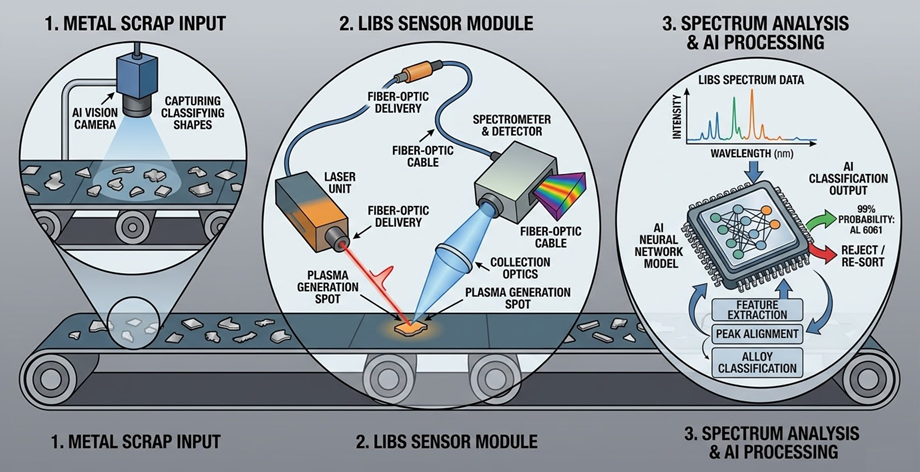
C. Laser-Induced Breakdown Spectroscopy (LIBS)
This is the pinnacle of 2026 recycling tech. A laser “zaps” a tiny spot on the metal, creating a plasma plume. The AI analyzes the light spectrum of that plasma to identify the exact chemical alloy (e.g., distinguishing 6061 aluminum from 7075 aluminum). This level of purity is what makes “Closed-Loop Recycling” possible.
Technical Specification Comparison Table
| Feature | Traditional Sorting | AI-Powered Sorting (2026) | Efficiency Gain |
| Sorting Speed | 5–10 tons per hour | 35–50 tons per hour | +400% |
| Purity Levels | 75% – 85% | 98.5% – 99.8% | +15% Purity |
| Labor Cost | High (Manual intense) | Low (Technical monitoring) | -60% Cost |
| Data Tracking | Manual logs (paper) | Real-time Cloud Analytics | Instant Reporting |
| Safety Risk | High (Human contact) | Zero (Automated) | 100% Reduction |
3. The Economic Imperative: Why Efficiency is the New Currency
In the 2026 scrap market, “Dirty Scrap” is a liability, while “Clean Scrap” is a premium commodity. Manufacturers in the EV and renewable energy sectors are now required by law to use a specific percentage of recycled content.
AI allows recycling plants to meet these strict purity standards. By eliminating human error, a plant can guarantee that a shipment of copper is 99.9% pure. This transparency is backed by the “Digital Product Passport” (DPP), a blockchain-linked record of the metal’s journey from the sorting belt to the foundry.
4. Bridging the Gap: Education and the Green Workforce
As the hardware becomes more complex, the demand for “Green-Collar” workers is skyrocketing. The industry no longer just needs forklift drivers; it needs “Algorithm Technicians” and “Sustainability Data Analysts.”
This shift is precisely Why AI Skills Matter for Gen Z because the future of the global economy is being built on the ability to manage automated systems that solve environmental crises. As universities update their curricula to include these industrial applications, students are increasingly required to produce high-level technical reports and simulations. Whether it is a project on robotic pathfinding or a thesis on the thermodynamics of metal recovery, the academic foundation is what will drive the next decade of innovation.
5. Overcoming the “Shredder” Challenge
One of the hardest materials to recycle has always been the “Automobile Shredder Residue” (ASR). When a car is shredded, it results in a chaotic mix of plastics, foams, and dozens of different metal alloys.
Previously, much of this was sent to landfills as “fluff.” Today, AI-driven “Robotic Pickers” use vacuum-sealed grippers and “Delta Robots” to pluck high-value components out of the fluff at lightning speed. This has increased the recovery rate of a typical end-of-life vehicle (ELV) from 80% to nearly 97%.
6. EPR Compliance: The Regulatory Driver
Extended Producer Responsibility (EPR) has moved from a suggestion to a strictly enforced global mandate in 2026. Governments now hold electronics and automotive manufacturers financially responsible for the “End-of-Life” of their products.
AI sorting provides the “Audit Trail” required for this compliance. Every ton of metal processed by an AI sorter is categorized and logged. This data is essential for:
- Tax Credits: Companies get rebates for verified recycling volumes.
- Carbon Credits: Accurate recycling data allows firms to offset their carbon footprint.
- Legal Defense: Proof of proper hazardous waste (like lead or mercury) separation.
7. The Future: Autonomous “Urban Mining”
Looking toward 2030, the trend is moving toward “Autonomous Urban Mining.” This involves portable, AI-integrated recycling units that can be deployed directly to demolition sites or manufacturing hubs. Instead of transporting heavy waste to a central plant, the waste is sorted and processed on-site, drastically reducing transportation emissions.
The software powering these mobile units relies on “Neural Networks” that learn on the fly. If the machine encounters a new type of hybrid alloy it hasn’t seen before, it uploads the data to the cloud, and within minutes, every other sorting machine in the network is updated on how to identify that material.
8. Final Thoughts: A Human-Centered AI Revolution
Despite the automation, the human element remains the most important factor. The logic, ethics, and strategic planning behind these systems come from the classrooms of today. As we integrate AI into our physical world, the ability to document, analyze, and improve these systems is the most valuable skill a person can possess.
For those entering the professional sphere, the transition to AI-driven sustainability represents a once-in-a-generation opportunity to combine technical proficiency with environmental stewardship. The journey from a discarded piece of “trash” to a high-value industrial component is now a journey of data, light, and intelligence.
Frequently Asked Questions
1. How does artificial intelligence identify different types of metal?
The system utilizes a combination of high-speed cameras and advanced sensors, such as X-ray fluorescence and lasers. These tools analyze the visual characteristics and atomic density of each item, allowing the software to distinguish between various alloys with precision that far exceeds human capability.
2. Can these automated systems handle contaminated or dirty materials?
Yes. Modern sorting technology is designed to recognize materials even when they are covered in paint, labels, or dirt. By using sensors that “see” through surface debris to identify the base chemical composition, the system ensures that high purity levels are maintained regardless of the initial condition.
3. What is the main benefit of upgrading from mechanical to intelligent sorting?
The primary advantage is the massive increase in recovery rates and material purity. Higher purity levels allow recycled metals to be used in high-end manufacturing rather than being downgraded, which significantly increases the market value of the processed scrap and supports a more sustainable production cycle.
4. How does the technology adapt to new types of consumer waste?
These systems are powered by neural networks that are constantly updated. When new hybrid materials or alloys enter the waste stream, the software can be retrained using new data sets, which are then shared across the network to ensure all processing units can identify the new materials immediately.
About The Author
Ella Thompson is a seasoned technical writer and researcher passionate about the intersection of sustainable technology and industrial innovation. With a background in environmental science, she specializes in translating complex engineering concepts into accessible insights. Ella is a frequent contributor to academic and industry journals, often collaborating with myassignmenthelp to bridge the gap between classroom theory and real-world application.